
Table of Contents
- Can AI Write My CV? What It Can and Cannot Do
- How to Use AI to Write a CV Without Losing Your Own Voice
- AI CV Prompts That Pull Out Real Evidence
- AI CV Examples: What Good Output Looks Like
- Tailor Your CV to the Job Description, Not Just the Keywords
- The Limits of AI: Made-Up Experience and Applicant Tracking Systems
- A Practical Workflow: From AI Draft to a CV You Can Defend
- Frequently Asked Questions
Last Updated: 20 October 2026
Can AI Write My CV? What It Can and Cannot Do
Can I use AI to write my CV? It can draft one, but it cannot supply the evidence that makes a CV credible. AI is good at structure, phrasing and tidying messy bullet points. It cannot know what you actually did at work. That gap matters, because employers and applicant tracking systems reward specific, accurate proof.
This guide from Evident Career Studio sets out where AI helps, where it fails, and how to keep your own voice in the draft. Below, we show exactly how to use AI to write a CV that you can defend in an interview.
AI CV writing is the use of a language model to draft, restructure or tighten CV content from information you provide. The output is only as good as your input. Feed it vague lines and you get polished vagueness back.
How to Use AI to Write a CV Without Losing Your Own Voice
Start with your own raw material, then let AI shape it. Never the other way round.
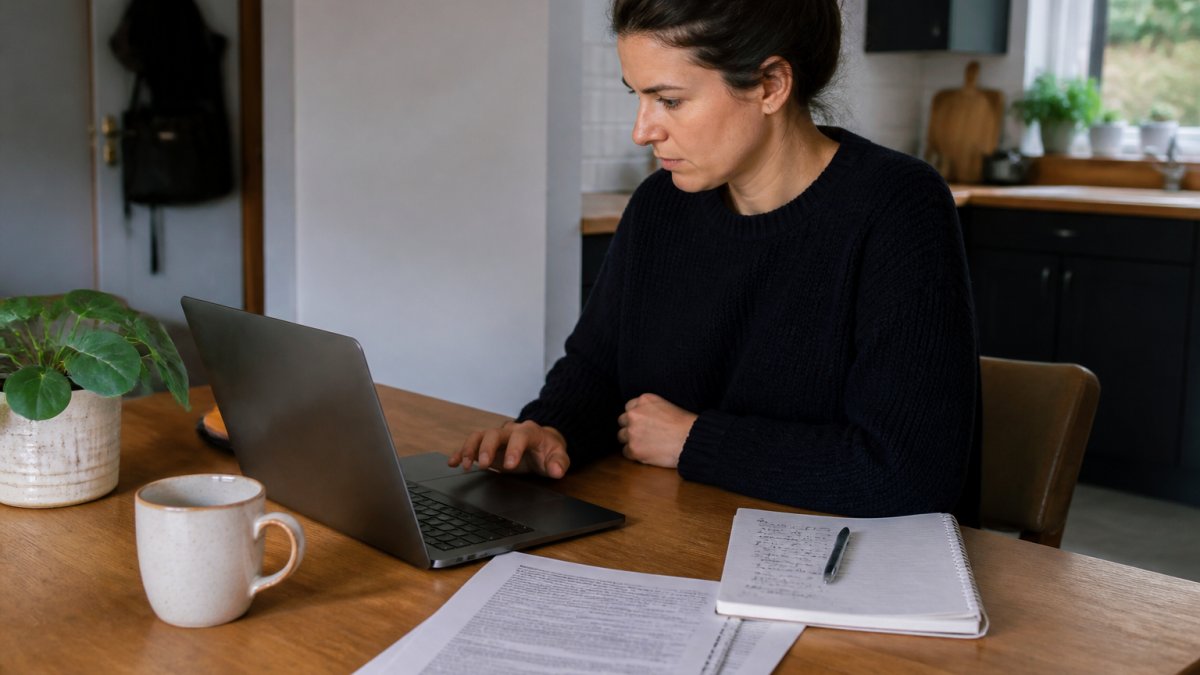
Write a rough list first: roles, dates, tasks, tools, results. Do this badly and quickly. Then hand that list to the AI and ask it to organise, not invent.
Keep these rules in mind:
- Give the AI facts, not adjectives. "Managed a rota for 12 staff" beats "dynamic team player".
- Ask for two or three versions of each bullet, then pick and edit.
- Read every line aloud. If it does not sound like you, rewrite it.
- Delete any phrase you could not explain in an interview.
The National Careers Service offers free guidance on CV structure, which is a sensible baseline before you prompt any tool.
AI CV Prompts That Pull Out Real Evidence
Good prompts ask for evidence, not polish. Weak prompts ask for a "professional CV" and get generic filler.
Try these:
- "Here are my notes for this role. Turn each point into a bullet with a clear action and a measurable outcome. Ask me for the number if it is missing."
- "Rewrite this bullet without adjectives. Keep only facts I can prove."
- "Identify which of my points are vague and tell me what detail would strengthen them."
- "Compare my bullets to this job advert and list the requirements I have not addressed."
That last prompt is where tailoring begins. A useful AI CV prompt always ends with a question back to you.
AI CV Examples: What Good Output Looks Like
Here is the difference in practice.
Weak AI output: "Responsible for delivering excellent customer service in a fast-paced environment."
Stronger, evidence-based version: "Handled 40+ customer enquiries a day across phone and email, resolving complaints at first contact and logging recurring issues for the team lead."
The second version is longer but defensible. It names a channel, a volume and an outcome. That is what AI CV examples should teach you: specificity beats polish.
A quick test before you keep any line:
- Does it name a real task, tool or result?
- Could a colleague confirm it happened?
- Would you be comfortable being asked about it in detail?
If any answer is no, cut the line.
Tailor Your CV to the Job Description, Not Just the Keywords
Matching keywords is the floor, not the ceiling. A CV stuffed with the advert's exact words but no proof reads as noise.
Read the advert twice. Highlight the duties, then the person specification. Map each requirement to a real example from your history. Where you have no example, note the gap honestly rather than inventing one.
This is where tailoring a CV to a job description does the heavy lifting: matching your evidence to what the employer actually asked for, rather than keyword-matching.
The UK government's Find a job service publishes application advice that reinforces the same point: employers want relevance, not volume.
The Limits of AI: Made-Up Experience and Applicant Tracking Systems
AI will invent detail if you let it. It fills gaps with plausible-sounding claims because it is predicting language, not checking facts.
Two risks follow:
- Fabricated experience. An invented metric or job title can surface in an interview and end your application.
- Applicant tracking systems. These parse your CV for structure and match terms. They reward clean headings, standard job titles and clear dates. They do not reward clever phrasing.
The Information Commissioner's Office sets out your rights over personal data, including how employers handle recruitment information. Accuracy in your own CV protects you here.
A Practical Workflow: From AI Draft to a CV You Can Defend
Follow this sequence and you keep the speed of AI with the accuracy of your own record.
Step | What you do | Why it matters |
|---|---|---|
1. Gather | List roles, dates, tasks, tools, results in plain notes | AI needs facts to work from |
2. Draft | Ask AI to structure and tighten your notes | Saves time on wording |
3. Check | Remove any claim you cannot evidence | Protects you in interview |
4. Tailor | Match bullets to the specific advert | Improves relevance |
5. Review | Run a free CV check for gaps and clarity | Catches what you missed |
For step five, the free CV checker gives feedback without an account. Use it as a second pair of eyes, then read the CV once more yourself.
The final test: could you sit in an interview and defend every line? If not, the draft is not finished.
Frequently Asked Questions
Can AI write my CV for me?
It can draft and tidy sections, but it cannot supply your real evidence. AI works best when you feed it facts about your jobs, results and skills, then edit the output so every claim is true. Treat it as a drafting assistant, not a replacement for your own record of what you did. You still need to check dates, job titles and achievements before you send it. If you want a starting point tailored to a specific advert, you can use a CV tailoring tool to align your real experience with the job description.
Is it acceptable to use AI to write a CV?
Using AI to help draft or tighten wording is generally acceptable, as long as the content is accurate and yours. Employers care about truth and relevance, not whether you used a tool to help you type. The risk comes when AI invents experience or produces generic text that does not match your background. Keep your own evidence at the centre, and use AI for structure, clarity and phrasing. If you are unsure, read the finished CV aloud: if you cannot defend a line in an interview, rewrite it.
Will employers know if I used AI to write my CV?
They may not know for certain, but generic AI text is easy to spot. Phrases that sound vague, repeated sentence structures and achievements without specifics stand out to recruiters. The bigger risk is being asked to explain a claim you cannot back up. The safest approach is to use AI CV prompts that pull out your real examples, then rewrite in your own words. A CV that reads like you and contains specific, checkable detail will always be stronger than a polished but hollow draft.
Can AI make up experience or qualifications?
Yes, and that is the main danger. AI tools can invent plausible-sounding jobs, dates or qualifications if you do not give them accurate information. Never accept a line you cannot prove. Check every employer name, date, job title and qualification against your own records. If a draft includes something you did not do, delete it. Making up experience is a fast route to rejection, and it can damage your reputation if an employer checks references.
AI can get you a fast first draft, but it cannot supply your evidence, and that is the part employers actually weigh. If you want the wording tightened and the content matched to a specific advert, Evident Career Studio tailors your CV to the job description and offers interview practice built around that same role. Start with the free CV checker to see where your current draft stands, then decide what to fix first.